Middlewares
litegram provides powerful mechanism for customizing event handlers via middlewares.
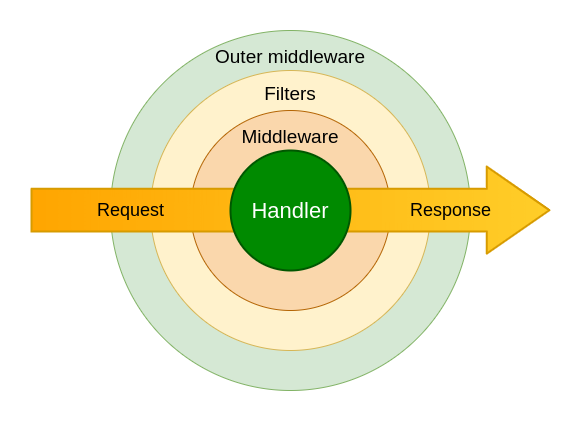
Middlewares in bot framework seems like Middlewares mechanism in web-frameworks like httpx, fastapi, Django or etc.) with small difference - here is implemented two layers of middlewares (before and after filters).
Note
Middleware is function that triggered on every event received from Telegram Bot API in many points on processing pipeline.
Base theory
As many books and other literature in internet says:
Middleware is reusable software that leverages patterns and frameworks to bridge the gap between the functional requirements of applications and the underlying operating systems, network protocol stacks, and databases.
Middleware can modify, extend or reject processing event in many places of pipeline.
Basics
Middleware instance can be applied for every type of Telegram Event (Update, Message, etc.) in two places
Outer scope - before processing filters (
<router>.<event>.outer_middleware(...))Inner scope - after processing filters but before handler (
<router>.<event>.middleware(...))
Attention
Middleware should be subclass of BaseMiddleware (from litegram import BaseMiddleware) or any async callable
Arguments specification
- class litegram.dispatcher.middlewares.base.BaseMiddleware[source]
-
Generic middleware class
- abstractmethod async __call__(handler: Callable[[T, dict[str, Any]], Awaitable[Any]], event: T, data: dict[str, Any]) Any[source]
Execute middleware
- Parameters:
handler – Wrapped handler in middlewares chain
event – Incoming event (Subclass of
litegram.types.base.TelegramObject)data – Contextual data. Will be mapped to handler arguments
- Returns:
Any
Examples
Danger
Middleware should always call await handler(event, data) to propagate event for next middleware/handler.
If you want to stop processing event in middleware you should not call await handler(event, data).
Class-based
from litegram import BaseMiddleware
from litegram.types import Message


class CounterMiddleware(BaseMiddleware):
    def __init__(self) -> None:
        self.counter = 0

    async def __call__(
        self,
        handler: Callable[[Message, Dict[str, Any]], Awaitable[Any]],
        event: Message,
        data: Dict[str, Any]
    ) -> Any:
        self.counter += 1
        data['counter'] = self.counter
        return await handler(event, data)
and then
router = Router()
router.message.middleware(CounterMiddleware())
Function-based
@dispatcher.update.outer_middleware()
async def database_transaction_middleware(
    handler: Callable[[Update, Dict[str, Any]], Awaitable[Any]],
    event: Update,
    data: Dict[str, Any]
) -> Any:
    async with database.transaction():
        return await handler(event, data)
Facts
Middlewares from outer scope will be called on every incoming event
Middlewares from inner scope will be called only when filters pass
Inner middlewares is always calls for
litegram.types.update.Updateevent type in due to all incoming updates going to specific event type handler through built in update handler